Most security education is disconnected from how vulnerabilities actually appear in code.
Students learn CWE concepts in isolation, without seeing how they emerge in their own implementations.
InjectEd embeds embeds vulnerabilities directly into student-submitted code, then evaluates and selects the most educational examples through a structured multi-agent pipeline.
Overview
InjectEd embeds transforms abstract secure coding concepts into personalized, code-level learning experiences.
Vulnerabilities are injected into the exact code students wrote—not into prebuilt examples.
Instead of relying on static exercises, the system operates on real student submissions, generating context-aware vulnerabilities aligned with assignment objectives and implementation details.
I designed and implemented InjectEd as an end-to-end multi-agent pipeline that injects vulnerabilities, evaluates their educational value, and generates structured learning artifacts grounded in the student’s own code.
The result is a system that turns theoretical security concepts into contextualized, experiential learning.
Role
Sole Engineer (System Design, Agent Architecture, Evaluation Framework)
- Designed and implemented the full multi-agent pipeline
- Defined evaluation criteria for ranking educational value of vulnerabilities
- Built all agents, orchestration logic, and data pipelines
- Collaborated with research team on study design and classroom deployment
What I Built
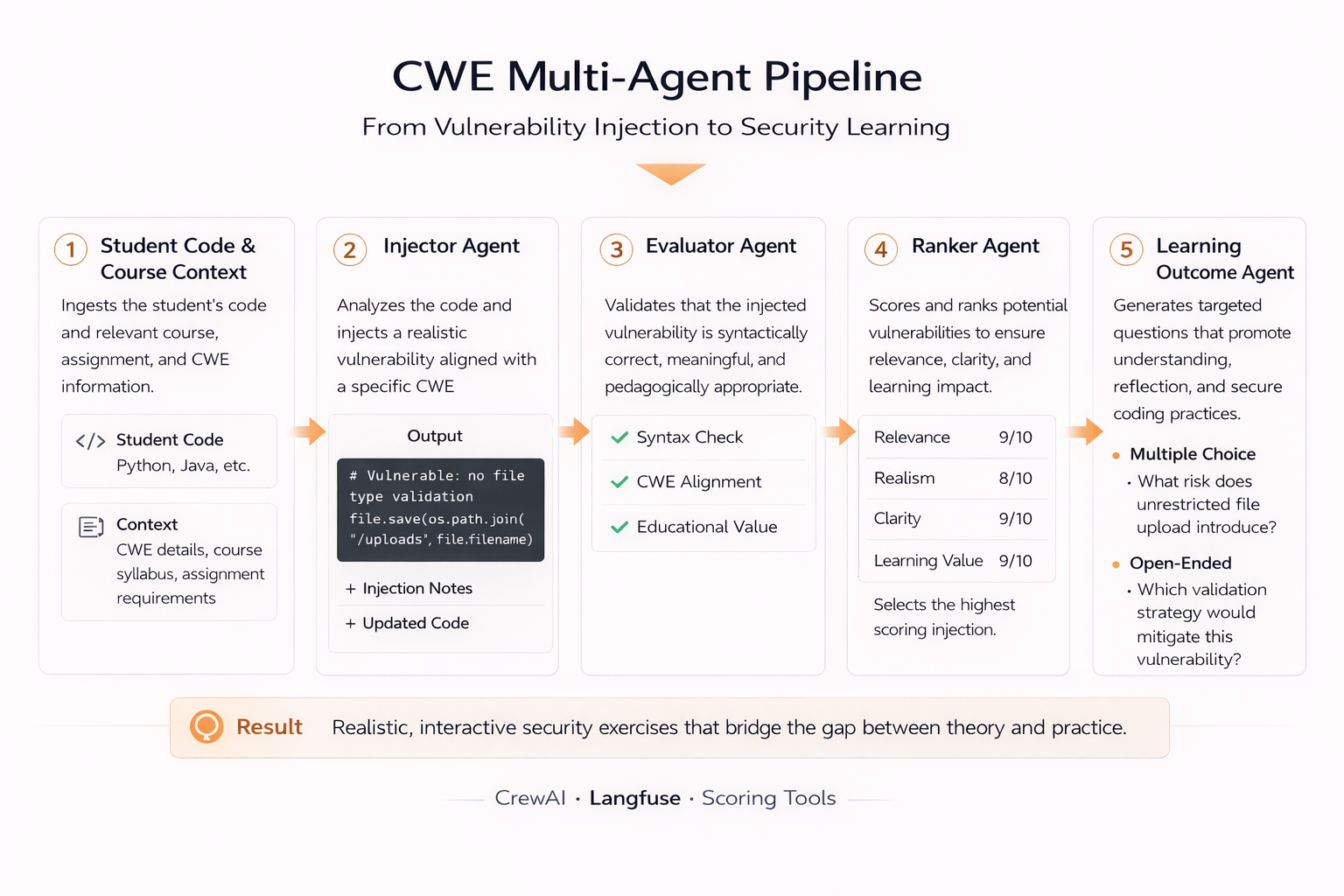
I developed InjectEd as a multi-agent system that formalizes vulnerability generation, evaluation, and selection within student code.
Generation alone is not enough—the system evaluates and selects what is most educational.
This included:
- CWE Injector Agent — inserts realistic vulnerabilities into high-signal regions of student code while preserving structural integrity
- CWE Evaluator Agent — scores candidates across realism, complexity, and pedagogical value using LLM-as-judge evaluation
- CWE Ranker Agent — selects the optimal vulnerability using weighted scoring and comparative reasoning
- Learning Outcome Agent — generates structured assessment questions grounded in the injected vulnerability and code context
All prompts, scoring logic, and evaluation workflows are managed through Langfuse, enabling versioning, experimentation, and traceability across the system.
System Design
The architecture is implemented as a staged agentic workflow with explicit separation between generation, evaluation, and selection.
- Input Context → student code, assignment specifications, course materials, and curated CWE mappings
- Injection Agent → generation of multiple vulnerability candidates
- Evaluation Agent → scoring using defined pedagogical and technical criteria
- Ranking Agent → selection of the optimal candidate through weighted comparison
- Learning Agent → generation of structured educational artifacts aligned with course objectives
Evaluation is the control mechanism—generation is only the first step.
Each stage produces structured outputs consumed by downstream agents, ensuring reproducibility and consistent system behavior.
The system operates as a coordinated reasoning pipeline, where outputs are validated and refined through successive stages rather than accepted at generation time.
Technical Constraints
A key challenge was balancing technical realism with instructional clarity.
Injected vulnerabilities needed to reflect real-world patterns while remaining understandable and relevant to the student’s implementation.
Challenges included:
- Preserving original code structure while introducing meaningful vulnerabilities
- Avoiding distortions that reduce educational clarity
- Designing evaluation criteria that capture both correctness and pedagogical value
- Maintaining consistency across multiple agents operating on shared context
To address this:
- Injection strategies were constrained to minimize structural disruption
- Evaluation criteria were weighted toward educational usefulness over novelty
- Structured outputs were enforced across all agents to ensure consistency and traceability
This produced a system that maintains realism without sacrificing instructional value.
Technical Focus
The system is built around:
- Multi-agent orchestration for staged reasoning and decision-making
- Evaluation-driven AI systems where scoring governs selection
- Programmatic code transformation for controlled vulnerability injection
- Structured LLM reasoning constrained by educational and contextual inputs
At its core, the project demonstrates how evaluation-driven pipelines produce more reliable and meaningful outcomes than generation alone.
Outcome
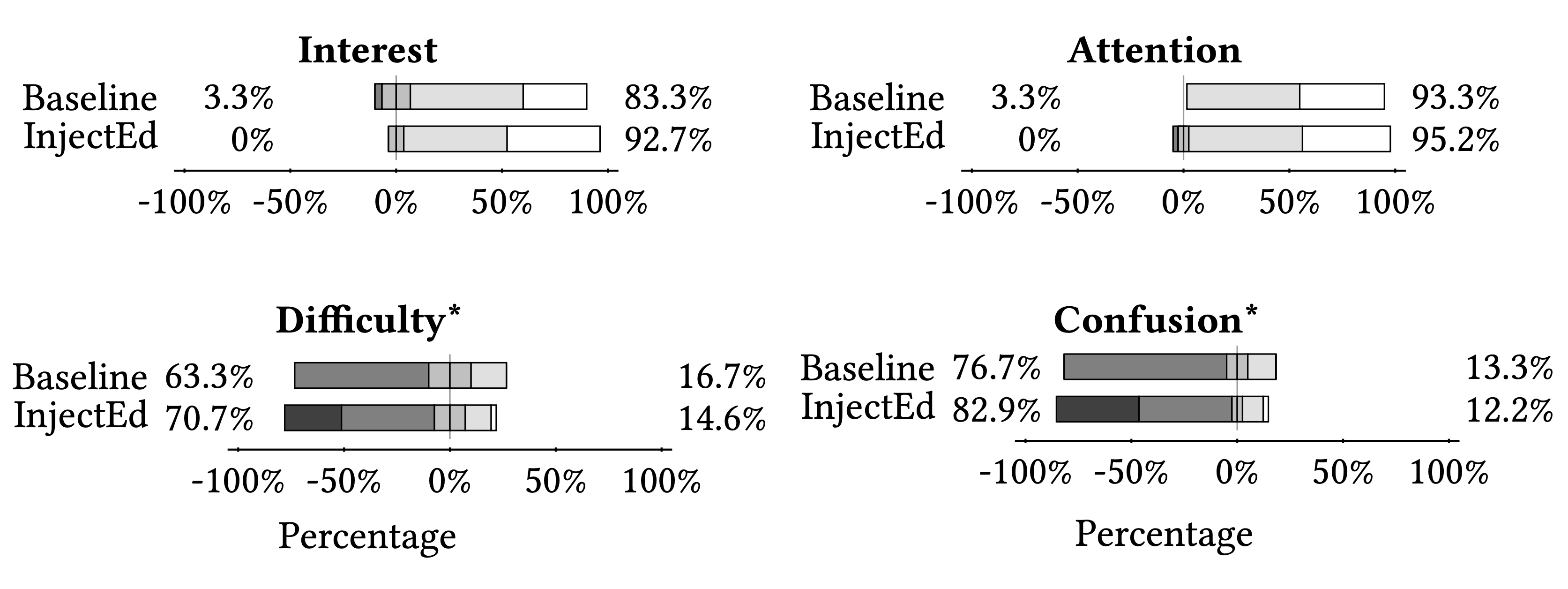
InjectEd was evaluated in a classroom setting to assess its impact on student understanding of secure coding practices. Instead of working with abstract examples, students engaged with vulnerabilities embedded in their own code.
“The vulnerability made me think differently about my code.”
“It showed a type of bug I did not realize my logic was vulnerable to.”
- Increased engagement through personalized, context-aware exercises
- Improved qualitative understanding of how vulnerabilities manifest in real implementations
- Strong positive feedback from students on relevance and clarity
- No statistically significant quantitative improvement, highlighting the difficulty of measuring learning outcomes in small samples
The project demonstrates how agentic AI systems like InjectEd can transform security education by making concepts experiential, contextual, and student-specific.
It also reinforces the importance of combining qualitative and quantitative evaluation when assessing educational systems.